What Is the Best Fiber Optic Cable Type from China?
Choosing the best fiber optic cable from China starts with the network, not the factory catalog. There is no universal winner. A rural aerial link may need ADSS cable, while a data center often favors compact, high-density designs. FTTH installers commonly examine G.657A1 or G.657A2 bend-insensitive fiber for tight corners and small indoor boxes. Long-distance backbone projects usually require single-mode G.652D fiber, carefully matched with transmission equipment. Multimode cable can suit shorter links, but it should not be selected merely because its price looks attractive. That shortcut can become expensive.
A responsible buyer should compare attenuation, tensile strength, bending performance, jacket materials, fire ratings, and connector compatibility. Ask Chinese manufacturers for factory test records, sample measurements, and compliance evidence aligned with ITU-T and IEC requirements. Independent laboratory verification is even better when the project carries serious operational risk. Factory audits can reveal details that product pages hide, such as uneven fiber coloring, poor sealing, or inconsistent packaging. I have found that clear drawings and small trial orders prevent many misunderstandings. Still, this method is not flawless. A polished sample may not represent every production batch. Delivery delays, changing materials, and weak technical support can also affect the final result. The best fiber optic cable is therefore the one that matches installation conditions, performance targets, maintenance plans, and supplier reliability. Price matters, but evidence matters more. Ask difficult questions. Then test the answer.
What Makes a Fiber Optic Cable Type Suitable for Different Applications?
Choosing the best fiber optic cable from China is not a simple country-based decision. The suitable type depends on distance, bandwidth, installation conditions, and maintenance plans. A cable should fit the application, not merely meet a low price.
Single-mode OS2 fiber suits long-distance links, data centers, and outdoor networks. It supports high bandwidth over many kilometers.
Multimode OM3 or OM4 is practical for shorter links inside buildings. It can simplify equipment selection.
For tight corners, G.657 bend-insensitive fiber reduces signal loss. This matters in crowded cabinets and apartment installations.
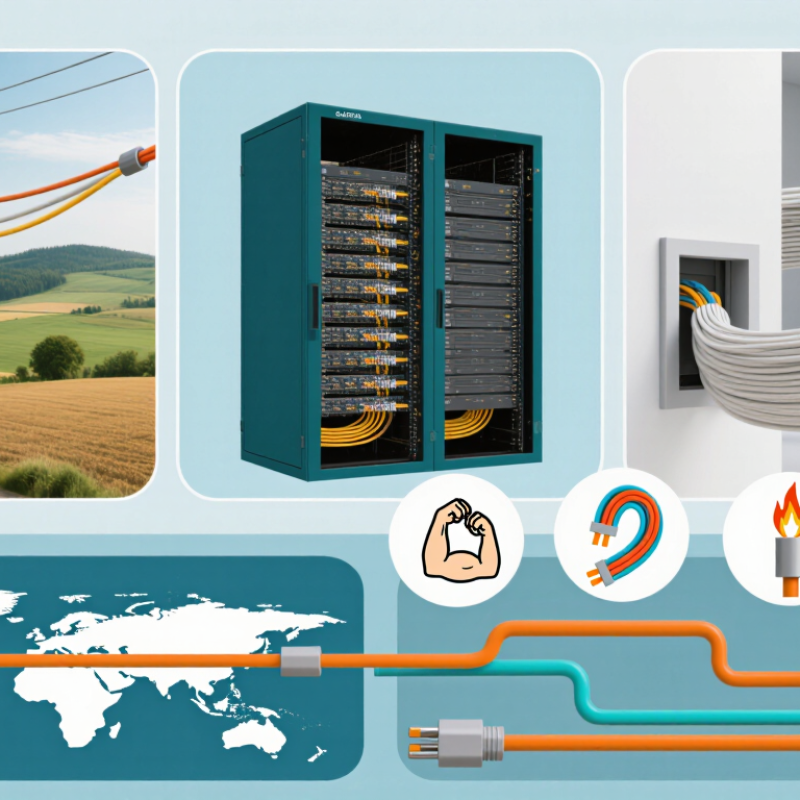
Armored cable helps protect fibers from crushing, rodents, and repeated handling. ADSS cable works well on aerial routes because it does not require a metallic messenger wire.
The environment decides more than the label. Wet ducts need reliable water blocking. High-traffic areas may require stronger jackets and better pull resistance.
During project inspections, technicians should check attenuation, return loss, tensile strength, and fire performance. OTDR testing can reveal hidden breaks or poor splices.
Standards such as ITU-T and IEC provide useful reference points, but paperwork alone is not enough. I have seen cables pass a visual inspection yet perform poorly after difficult installation. That experience is easy to overlook.
Request traceable test reports, sample testing, and clear construction drawings before ordering.
A suitable cable balances performance, protection, installation speed, and future upgrades. Sometimes, the cheapest option becomes expensive after rework.
How to Compare Single-Mode and Multimode Fiber Cables from China
What Is the Best Fiber Optic Cable Type from China?
When comparing single-mode and multimode fiber cables from China, begin with distance and transmission speed. Single-mode OS2 fiber usually supports 10G links up to 10 kilometers with suitable optics, according to IEEE 802.3 specifications. Its typical attenuation is about 0.4 dB/km at 1,310 nanometers under ITU-T G.652.D guidance. It suits telecom backbones, campus links, and outdoor networks. Distance changes everything.
Multimode OM3 and OM4 cables are more practical inside buildings. IEEE 802.3 lists 100GBASE-SR4 reach at 70 meters on OM3 and 100 meters on OM4. Multimode optics often cost less and simplify short data-center connections. However, modal dispersion limits future upgrades. A 300-meter warehouse link may work well today, yet become restrictive after a speed upgrade.
For Chinese cable sourcing, request factory OTDR traces, attenuation tables, geometry results, and tensile-test records. Check compliance with IEC 60794 and the relevant ITU-T fiber category. Inspect the jacket printing, fiber count, bend radius, and water-blocking design before installation. An independent laboratory report is stronger than a supplier spreadsheet. Measure it. Some quotations look attractive because they exclude connectors, testing, or protective construction. That comparison is incomplete. A practical acceptance test should include insertion loss, return loss, polarity, and visual end-face inspection. In my experience, the cheapest cable can create the most expensive troubleshooting visit. Geological conditions, installation skill, and cleaning discipline also matter more than many buyers expect.
What Is the Best Fiber Optic Cable Type from China? – How to Compare Single-Mode and Multimode Fiber Cables from China
| Comparison Dimension | Single-Mode Fiber Cable | Multimode Fiber Cable | Practical Selection Guidance |
|---|---|---|---|
| Common Fiber Designations |
OS1 and OS2 OS2 is the common low-water-peak, loose-tube or tight-buffered single-mode option for modern outside-plant and long-distance networks. |
OM1, OM2, OM3, OM4, and OM5 OM3 and OM4 are commonly used for higher-speed short-distance data-center links. |
Select the designation that matches the optical modules, network standard, and required transmission distance. |
| Typical Core and Cladding Size | Approximately 9/125 µm core/cladding geometry. | Typically 50/125 µm; OM1 is commonly 62.5/125 µm. | Core size is not interchangeable between single-mode and multimode systems. The cable type must match the transceiver and patching system. |
| Primary Operating Wavelengths | Commonly 1310 nm and 1550 nm; some systems also use 1490 nm or wavelength-division multiplexing bands. | Commonly 850 nm; some OM5 systems are designed for short-wavelength division multiplexing applications. | Verify the transceiver wavelength, connector loss, and cable attenuation requirements before ordering. |
| Distance Capability | Suitable for access, metropolitan, campus, telecom, and long-haul links. Reach can extend from several kilometers to tens of kilometers or more, depending on the optical equipment. | Optimized for short-reach links, generally within buildings, data centers, equipment rooms, and campus backbones. Reach depends strongly on OM grade and link speed. | Single-mode is normally the safer choice when the distance may expand or future network upgrades are expected. |
| Typical Data-Center Reach Examples | Modern single-mode optics can support several-kilometer connections, subject to the selected Ethernet or telecommunications specification. | At 10 Gb/s, OM3 and OM4 commonly support approximately 300 m and 400 m, respectively, when used with compatible 850 nm optics. | Treat published reach as a maximum design value. Actual results depend on insertion loss, connector quality, polarity, splices, and transceiver specifications. |
| Bandwidth and Modal Dispersion | Has very low modal dispersion because the fiber carries one primary propagation mode, making it suitable for high bandwidth and long distances. | Multiple propagation modes create modal dispersion, which limits distance at higher data rates. Higher OM grades provide improved bandwidth performance. | For 40 Gb/s, 100 Gb/s, 400 Gb/s, or faster links, confirm the exact optical standard and supported multimode or single-mode reach. |
| Attenuation Reference | Modern OS2 fiber commonly has maximum attenuation values around 0.4 dB/km at 1310 nm and 0.3 dB/km at 1550 nm, depending on the applicable specification. | Typical maximum attenuation is often around 3.0 dB/km at 850 nm and 1.0 dB/km at 1300 nm, depending on the fiber category and standard. | Use the manufacturer’s test report and the applicable IEC or TIA specification for final link-budget calculations. |
| Transceiver Compatibility | Requires single-mode optical modules, commonly identified by single-mode applications and wavelengths such as 1310 nm or 1550 nm. | Requires multimode-compatible optical modules, commonly using 850 nm VCSEL technology for short-reach Ethernet applications. | Never select the cable based only on connector type. A matching LC or MPO connector does not guarantee optical compatibility. |
| Installation Environment | Suitable for indoor, outdoor, duct, direct-buried, aerial, campus, metropolitan, and telecom installations when the correct cable construction is selected. | Primarily used for indoor structured cabling, data centers, enterprise networks, and short building-to-building links. | For outdoor procurement, specify jacket material, water blocking, crush resistance, tensile strength, temperature range, and installation method. |
| Future Expansion Potential | Strong long-term flexibility for longer distances, wavelength-division multiplexing, campus expansion, and higher-capacity network upgrades. | Cost-effective for stable, short-distance applications, but distance and speed limitations should be reviewed before major infrastructure deployment. | Choose single-mode when the project has uncertain future distances or requires a consistent fiber platform across multiple locations. |
| Relative Equipment and Deployment Cost | The cable itself can be competitively priced, but compatible optical modules may have different costs depending on distance, wavelength, and transmission rate. | Short-reach optical modules and indoor deployment can be economical for compact networks, especially where the required distance is limited. | Compare the total installed cost, including transceivers, patch panels, connectors, testing, labor, and future upgrade requirements. |
| China Sourcing Quality Checks | Request fiber type, attenuation, chromatic dispersion, cutoff wavelength, tensile strength, jacket details, and factory test documentation. | Request OM classification, effective modal bandwidth, attenuation, differential mode delay data when applicable, jacket details, and test documentation. | Ask for samples, optical test results, dimensional tolerances, packaging details, production lead time, and inspection procedures before placing a large order. |
| Applicable Standards to Verify | Confirm compliance with relevant portions of ITU-T G.652, IEC 60793, IEC 60794, TIA-568, and the project’s local requirements. | Confirm compliance with relevant portions of IEC 60793-2-10, IEC 60794, TIA-568, and the required OM classification. | Standards should be verified against the complete cable assembly, not only the bare optical fiber. |
| Best General Application | Telecom networks, carrier access, metropolitan links, campus backbones, long-distance connections, outdoor routes, and upgrade-oriented infrastructure. | Data centers, server rooms, enterprise LANs, storage-area networks, and short-distance high-density indoor connections. | For most long-distance or outdoor projects, choose single-mode. For short indoor links with known limits, choose the appropriate multimode grade. |
Note: Performance values are typical reference ranges rather than guaranteed specifications. Final selection should be based on the complete optical link budget, applicable standards, transceiver datasheets, installation conditions, and acceptance-test requirements.
Which Fiber Cable Designs and Standards Should Buyers Evaluate?
Choosing a fiber optic cable from China should begin with the network, not the factory catalogue. Start with distance. For long outdoor routes, single-mode OS2 is usually the practical baseline. G.652.D supports standard long-haul transmission, while G.657.A1 or A2 handles tighter bends near access points. Indoor links may use multimode OM3, OM4, or OM5, but the transceiver and distance must match. More bandwidth is not automatically better.
Buyers should compare loose-tube, tight-buffered, ribbon, armored, ADSS, and drop-cable constructions against the installation environment. Loose tubes protect fibers from moisture and temperature movement. Tight-buffered cables simplify indoor termination. Ribbon designs can reduce splice time, although they need compatible equipment. For aerial routes, check tensile strength, span rating, wind loading, and water-blocking performance. For buildings, review flame and smoke requirements under relevant IEC or regional classifications. IEC 60794 test methods support cable evaluation, while ITU-T and IEEE documents help confirm transmission compatibility.
Request measured attenuation, return loss, geometry, proof-test, crush, impact, and bend-cycle results. Do not rely on a polished datasheet. Ask for batch traceability, inspection records, sample testing, and clear tolerance limits. Verify connector end-face quality under a microscope. Field teams often discover that a compliant cable still fails after poor handling. No design is flawless. A small mismatch can create extra splice work, inconsistent lengths, or unexpected installation loss. Paper compliance cannot replace a controlled trial.
What Is the Best Fiber Optic Cable Type from China?
Maximum link distance by fiber design and common Ethernet application. Buyers should match the cable type with transmission speed, link distance, connector performance, and applicable standards.
OM3, OM4, and OM5 multimode fiber are commonly used for short-reach data-center links, while OS2 single-mode fiber supports much longer distances. The values are based on typical maximum reaches specified for IEEE Ethernet applications, including 10GBASE-SR, 40GBASE-SR4, 100GBASE-SR4, and 10GBASE-LR. When evaluating products, buyers should also verify ISO/IEC 11801, IEC 60793, TIA-568.3-D, insertion loss, return loss, attenuation, fiber count, jacket construction, flame rating, and RoHS compliance.
How to Assess Chinese Fiber Optic Cable Quality and Reliability
A reliable assessment starts with the application, not the country of origin. Origin alone proves nothing. For long-distance networks, single-mode fiber usually offers lower loss and greater reach. Data centers may need bend-insensitive fiber for crowded racks and sharp routing paths. Ask for the fiber classification, attenuation values, tensile strength, and operating temperature range. These details should match current IEC and ISO/IEC requirements.
Request an unedited factory test report for every production batch. Check insertion loss, return loss, geometry, proof testing, and cable length accuracy. A trustworthy supplier can provide traceability from fiber reel to finished drum. Examine the cable jacket closely. Printing should remain clear after rubbing, while connectors should fit without excessive force. Small defects often reveal weak process control.
Independent sampling is worth the cost. Send samples to an accredited laboratory when the project is large or difficult to replace. Test performance before installation, then repeat measurements after pulling and splicing. A cable can pass factory inspection yet fail after rough handling. That matters more than a polished brochure. I have learned that low price comparisons can miss packaging damage, unstable coating quality, and inconsistent documentation. No evaluation is perfect. Keep records, question unusual results, and inspect several batches instead of trusting one attractive sample. Supplier response time also matters when a field problem appears.
How to Choose the Best Chinese Fiber Optic Cable Supplier
Choosing the best Chinese fiber optic cable supplier starts with your installation, not a product catalog. Single-mode cable suits long-distance telecom links, while multimode cable often fits shorter data-center routes. A supplier should explain this difference clearly. Avoid vague claims.
Ask for technical data before discussing price. Check attenuation, return loss, tensile strength, bend radius, and operating temperature. Request sample cables from the same production line used for bulk orders. Test them with an OTDR and an insertion-loss meter. Small details matter, such as connector cleanliness and jacket printing.
A reliable supplier can provide factory registration, quality certificates, material records, and batch-level inspection reports. Review whether these documents match the actual cable structure. A polished website proves little. Video audits or an independent factory inspection can reveal storage conditions, testing equipment, and production discipline. Look for covered reels, dry warehouses, and labeled raw materials.
Communication is another practical test. Ask for a drawing, packing plan, production schedule, and response to a defect scenario. Strong suppliers answer with measurements, not slogans. Confirm packaging strength for sea transport and verify replacement terms in writing. Lead time may look attractive, but rushed production can weaken consistency. No supplier is perfect. Even experienced buyers should leave room for retesting, revised specifications, and an uncomfortable second opinion.
Related Posts
-
7 Tips to Choose the Right Fiber Optic Wire
-

What Are the Top China Optic Cable Suppliers?
-
Why Choose Fiber Optic Ethernet Cable for Global Networks?
-
What Are the Top Types of Fiber Cable?
-

Top 10 Benefits of Fiber Patch for Enhanced Performance and Recovery
-

How to Choose the Right Fiber Patch for Your Needs?