7 Tips to Choose the Right Fiber Optic Wire
Choosing the right fiber optic wire can determine whether a network remains stable or becomes a source of constant troubleshooting. The decision affects signal distance, bandwidth, installation effort, and long-term maintenance. A cable that looks suitable in a product photo may fail when routed through tight conduits, exposed to heat, or connected to mismatched equipment.
This guide presents seven practical tips for evaluating fiber optic wire before purchase. It considers single-mode and multimode designs, core size, jacket materials, connector compatibility, and indoor or outdoor installation conditions. It also explains why bend radius, pulling strength, and insertion loss deserve attention, even in smaller network projects. These details are easy to overlook. They often create expensive problems later.
Reliable selection should combine manufacturer specifications, field experience, and careful testing. Check technical data sheets instead of trusting marketing phrases alone. Confirm compliance with relevant industry standards, and ask whether the cable has been tested as a complete assembly. An experienced installer may also inspect pathway conditions, dust exposure, and available service space before recommending a product. Still, no checklist is perfect. Real buildings contain awkward corners, crowded panels, and unexpected changes. That is why thoughtful planning should leave room for inspection and adjustment. The right choice is not always the cheapest or fastest option. It is the cable that matches the equipment, environment, installation method, and expected future demand.
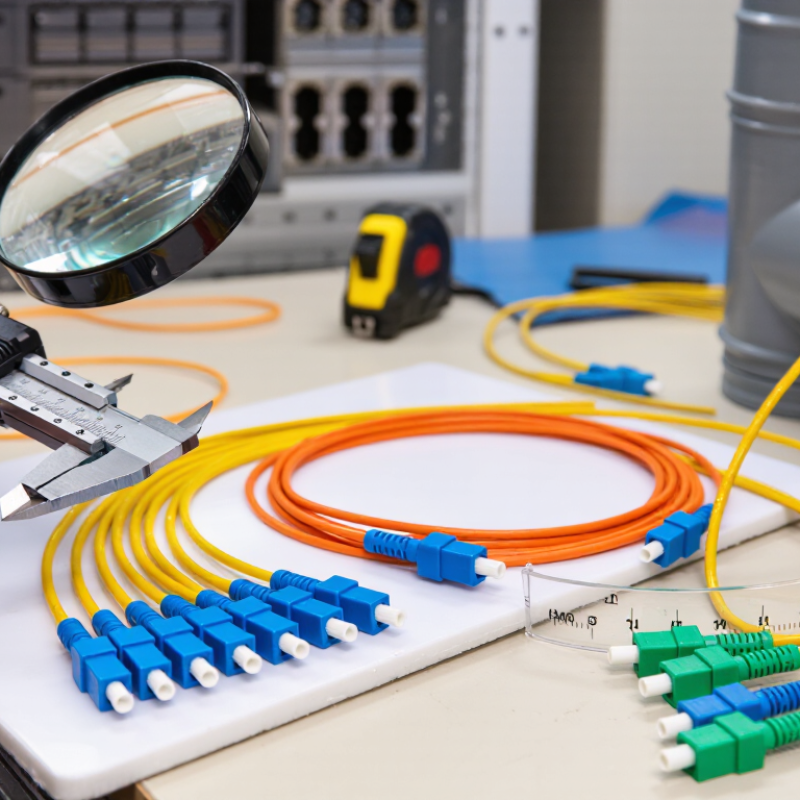
Define the Fiber Optic Wire Requirements for Your Network
7 Tips to Choose the Right Fiber Optic Wire
Define the Fiber Optic Wire Requirements for Your Network
Start with the network’s actual requirements, not the cable catalog. The ITU Facts and Figures 2023 report counted 5.4 billion internet users, representing 67% of the global population. That growth increases pressure on backbone, campus, and data center links. Write down required bandwidth, link distance, upgrade targets, and acceptable downtime before choosing fiber.
For long building-to-building routes, single-mode fiber usually provides greater reach and lower signal loss. Multimode fiber can suit shorter indoor connections with compatible equipment. Check the transmission standard, wavelength, connector type, and optical budget together. A 2-kilometer route may still fail when connectors, splices, and tight bends consume the margin. Measure twice.
Environmental details matter. Select armored cable for exposed pathways, flame-rated jackets for occupied buildings, and bend-insensitive fiber for crowded cabinets. The ITU Global Connectivity Report identifies affordability, quality, and infrastructure as major connectivity factors. Therefore, a cheaper cable can create higher installation costs later. In field surveys, I have seen well-rated fiber underperform because technicians ignored bend radius. That mistake is easy to repeat. Leave service loops, label both ends, and test every installed link with an optical loss test set. Perfect planning is rare. Recheck the assumptions.
Choose Between Single-Mode and Multimode Fiber
Choosing fiber starts with distance, not price. The ITU Facts and Figures 2023 report counted 5.4 billion internet users worldwide. The OECD Broadband Statistics for December 2023 also showed fiber reaching 42.9% of fixed broadband connections. These figures suggest heavier network demand, but they do not make every fiber type suitable.
Tip 1: Choose single-mode fiber for long routes. Its small core, usually 9/125 micrometers, carries signals with low modal dispersion. It supports campus links, carrier networks, and distances of many kilometers. However, single-mode optics require accurate alignment. Installation errors can become expensive.
Tip 2: Choose multimode fiber for shorter, controlled spaces. OM3 and OM4 commonly use a 50/125-micrometer core and 850-nanometer optics. Under TIA-568.3-D guidance, OM3 can support 10 Gigabit Ethernet up to 300 meters. OM4 can reach 400 meters. For 40 or 100 Gigabit links, typical limits fall near 100 and 150 meters. Measure the route carefully. Patch panels, bends, and connectors consume margin. A shorter cable is not always safer. I have seen designs fail because the equipment distance was checked, but the complete link was not. The cheapest option can be wrong. Recheck the transceiver specification, cable grade, connector cleanliness, and future capacity before ordering.
Match the Fiber Type to Distance, Speed, and Bandwidth Needs
7 Tips to Choose the Right Fiber Optic Wire
Match the fiber type to distance, speed, and bandwidth needs. Multimode fiber often suits short links inside buildings. Single-mode fiber is usually better for longer campus or outdoor runs. Check the required transmission speed, connector type, and optical budget before ordering. A higher bandwidth rating does not automatically solve every installation problem. Cable routing, bends, and connection quality also affect performance. I have seen short links fail because installers ignored excessive bending.
Tip 1: Measure the real distance, including service loops.
Tip 2: Choose multimode for practical short-range links and single-mode for extended distances.
Tip 3: Confirm that the fiber category supports your target speed.
Tip 4: Compare bandwidth requirements with future upgrades.
Tip 5: Check the cable’s bend radius before installation. Small details matter.
Tip 6: Verify connector compatibility with every device.
Tip 7: Review insertion loss and return loss in the technical datasheet.
After installation, test the link with an optical power meter and a light source. An OTDR can help locate breaks, sharp bends, or poor splices. Do not rely only on a link light. It may appear normal while performance remains unstable. I sometimes prefer leaving extra capacity, although that choice can increase cost without a clear benefit. The best selection balances distance, speed, bandwidth, installation conditions, and verified test results.
Evaluate Connector, Jacket, and Installation Compatibility
7 Tips to Choose the Right Fiber Optic Wire
Connector compatibility should be checked before cable length or price. According to the ITU’s Facts and Figures 2023, about 67% of the global population used the internet, increasing pressure on network reliability. Match the connector type, polish, fiber mode, and adapter alignment. TIA-568.3-E recognizes 0.75 dB as the maximum insertion loss for a connector pair in many structured-cabling designs. I still verify actual loss with a light source and power meter. A connector may look clean and still fail testing.
Jacket selection depends on location, fire exposure, moisture, and pulling conditions. Indoor plenum spaces may require low-smoke, flame-resistant construction under applicable safety rules. Outdoor runs need protection against ultraviolet exposure, water, rodents, and temperature swings. The wrong jacket can crack beside a ceiling tray. Do not treat “indoor/outdoor” as a complete specification.
Installation compatibility is equally practical. Check the cable’s minimum bend radius, pulling tension, crush resistance, and connector clearance. ITU-T G.657.A2 fiber supports tighter bends than conventional designs, with a standardized minimum bend radius commonly reaching 7.5 mm. However, the complete cable may require more space. I once planned around the fiber rating and ignored the jacket diameter. That mistake created unnecessary stress near the termination box. Leave service loops, protect entry points, and test after every major routing change. Perfect plans still meet imperfect walls.
Compare Quality, Standards, and Total Purchase Cost
7 Tips to Choose the Right Fiber Optic Wire
Compare Quality, Standards, and Total Purchase Cost
Tip 1: Define the link before comparing prices.
Confirm fiber type, core count, distance, indoor rating, bend radius, and connector design.
Tip 2: Check compliance with IEC 60794 and relevant ITU-T standards, such as G.652.D or G.657.A2.
Standards reduce compatibility risks.
Tip 3: Request test reports for attenuation, insertion loss, return loss, and tensile strength.
Do not trust a label alone.
Tip 4: Inspect the jacket closely.
A clean print, stable coating, and consistent diameter reveal better process control.
Tip 5: Calculate total purchase cost, not only the reel price.
Include connectors, trays, testing labor, transport, installation time, spare lengths, and future repairs.
The ITU’s Facts and Figures 2023 reported 5.4 billion Internet users worldwide. That growth increases pressure on reliable network capacity. A cheaper cable can become expensive when testing fails or installation slows.
Tip 6: Compare warranty terms, batch traceability, and technical support.
Ask for sample measurements from the exact production batch. This is practical, though often overlooked.
Tip 7: Compare lifecycle value over five to ten years.
Consider moisture protection, bend performance, fire rating, and expected upgrade needs.
I would not choose the lowest quote automatically. Sometimes, I have focused too heavily on specifications and missed labor costs. A clear spreadsheet helps.
Record every assumption, including local wages, test equipment, and replacement time. Industry guidance from BICSI and IEC documents supports disciplined design, but site conditions still require professional judgment.
Related Posts
-
What Are the Top China Optic Cable Suppliers?
-
What Are the Top Types of Fiber Cable?
-

Top 10 Benefits of Using Fiber Network Cable for Your Internet Connections
-

2026 Top Trends in Fiber Network Cable Technology and Its Applications?
-

Top Fiber Cable Types and Their Uses in Modern Networking?
-
Top 10 Optic Cable Suppliers in China for Global Buyers?