Top Fiber Cable Types and Their Uses in Modern Networking?
In today's digital age, the importance of fiber cable cannot be overstated. Experts like Dr. Emily Parker, a leading figure in networking technology, highlight, "Fiber cables are the backbone of our high-speed internet." This underscores their critical role in modern connectivity.
Fiber cables come in various types, each suited for specific applications. For instance, single-mode fiber cables are ideal for long-distance communication. Conversely, multimode fiber cables excel in short-distance transmissions. Understanding these distinctions is vital for optimizing network performance.
However, many still overlook their potential. Not all businesses utilize fiber cable effectively, often resulting in suboptimal network speeds. As technology continues to advance, it’s crucial to rethink how we integrate these cables into our infrastructure. The future will demand more from fiber optic solutions.
Top Fiber Cable Types in Modern Networking: An Overview
Fiber optic cables are essential in modern networking. They are known for their speed and reliability. There are different types of fiber cables, each serving unique purposes. Single-mode fiber cables are designed for long-distance data transmission. They use a single light path, making them efficient over vast distances. This type is used in telecommunications and internet backbones.
On the other hand, multi-mode fiber cables are suitable for shorter distances. They carry multiple light signals, allowing for faster data transfer within buildings. You often find these in local area networks (LANs). The choice between single-mode and multi-mode involves understanding the specific requirements. It’s crucial to reflect on the networking environment. The wrong choice can lead to data loss or slower speeds.
Choosing the right fiber cable is not just about speed. It’s also about compatibility with existing infrastructure. Factors like cable length and connector type play a significant role. Inadequate planning can lead to performance bottlenecks. Technology moves quickly, and staying updated is vital.
Top Fiber Cable Types and Their Uses in Modern Networking
Single-Mode vs. Multi-Mode Fibers: Key Differences and Applications
Single-mode and multi-mode fibers serve distinct purposes in modern networking. Single-mode fibers have an ultra-thin core, typically around 9 microns. This allows light to travel straight down the fiber. As a result, they can transmit data over long distances with minimal loss. They are often used for long-haul telecommunication and internet connections. Their ability to handle higher bandwidth makes them preferred for point-to-point communications.
On the other hand, multi-mode fibers have a larger core, about 50 or 62.5 microns. This design allows multiple light modes to propagate through the fiber. While it limits the distance for effective data transmission, it is ideal for shorter runs, like within a building or campus. These fibers are often used in local area networks (LANs) and for connecting servers to switches. They are cost-effective for specific applications but might not serve well in larger setups.
Understanding these differences is crucial for network engineers. Selecting the wrong fiber type can lead to reduced performance. Awareness of these factors can save time and costs in networking projects. Both fiber types play essential roles, but knowing their characteristics allows for better decision-making.
Common Uses of Fiber Optic Cables in Telecommunications Industry
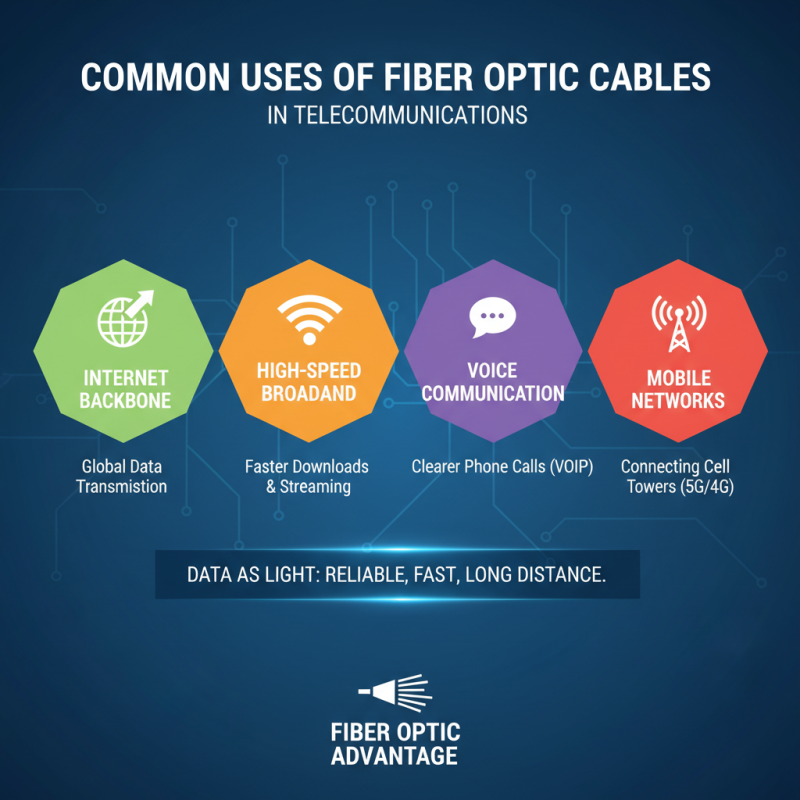
Fiber optic cables play a crucial role in the telecommunications industry. They transmit data through light signals, offering high-speed communication over long distances. This capability significantly enhances internet speeds and voice quality. Many telecom providers now rely heavily on fiber cables to meet customer demands.
In modern networking, different types of fiber cables are used for various applications. Single-mode fiber is ideal for long-distance transmission. It allows data to travel faster and over greater distances with minimal signal loss. On the other hand, multimode fiber is more suitable for shorter distances. It supports multiple light paths, making it perfect for data centers and local area networks. However, choosing the right type can be complex.
Despite many benefits, challenges still exist. Installation can be costly and time-consuming. Additionally, maintenance requires specialized knowledge. Many technicians still struggle with fiber splicing. Training is necessary, but often overlooked. As technology evolves, staying updated is vital for effective use in telecommunications. Improving practices and efficiency is an ongoing process.
Emerging Trends in Fiber Optic Technology and Network Expansion
Emerging trends in fiber optic technology are revolutionizing network expansion. As data demand rises, the need for faster, more reliable connections becomes essential. One key trend is the development of multi-core fiber cables. These cables can transmit more data simultaneously, improving efficiency significantly. They are becoming commonplace in high-density data centers.
Another noteworthy trend is the shift towards greener technology. Fiber optic networks require less power, making them eco-friendly. Innovations in manufacturing and installation methods reduce waste and resource consumption. These advancements not only support sustainability but also lower operational costs over time.
However, challenges remain. Adoption rates vary across regions, and knowledge gaps exist in deploying fiber networks. Some companies struggle to train staff on new technologies. As the industry evolves, there is a need for ongoing education and adaptation. Organizations must be mindful of these obstacles while embracing the future of connectivity.
Top Fiber Cable Types and Their Uses in Modern Networking
| Fiber Cable Type |
Description |
Common Uses |
Advantages |
| Single-mode Fiber |
Designed for long-distance communication |
Telecommunications, Internet backbone |
High bandwidth, low signal attenuation |
| Multi-mode Fiber |
Used for short-distance communication |
Local area networks (LANs), data centers |
Lower cost, easier to connect |
| Armored Fiber |
Reinforced to protect against physical damage |
Industrial, outdoor environments |
Durability, protection against rodents |
| Loose Tube Fiber |
Fiber strands are not tightly bound |
Long-haul networks, outdoor installations |
Effective for temperature fluctuations |
| Tight Buffered Fiber |
Fiber strands are tightly coated |
Indoor wiring, patch cables |
Simplicity in terminations and installations |
Benefits of Fiber Cables in High-Speed Internet Connectivity
Fiber optic cables have become essential for high-speed internet connectivity. They offer unmatched advantages when compared to traditional copper cables. A report from the Fiber Broadband Association highlights that fiber networks deliver speeds of up to 1 Gbps and beyond. This capability is crucial for seamless video streaming and online gaming.
One major benefit of fiber cables is their high bandwidth capacity. Compared to copper, fiber can transmit data over longer distances without losing quality. According to a study by Broadband Technology Report, fiber optic installations are 10 times faster than their copper counterparts. This rapid data transmission supports a growing demand for online services and cloud applications.
Besides speed, fiber cables are also more reliable. They are less susceptible to electromagnetic interference. A survey indicates that 75% of users report fewer outages when using fiber networks. However, the initial costs for fiber installation can be high. This investment can be daunting for smaller businesses. Balancing cost and performance remains a challenge.