Top Fiber Patch Cord Suppliers for Global Buyers
Choosing the right fiber patch cord supplier can influence network stability, installation speed, and long-term maintenance costs. For global buyers, product quality is only one part of the decision. Reliable communication, consistent documentation, flexible production, and dependable shipping also matter. A supplier may offer attractive prices, yet weak testing or unclear specifications can create expensive problems later. This guide examines leading fiber patch cord suppliers serving international markets. It focuses on manufacturing experience, connector quality, customization, certifications, and after-sales support.
Real-world performance begins with precise details. Buyers should review fiber types, polishing methods, insertion loss, return loss, jacket materials, and operating temperatures. A professional supplier should provide clear test reports and explain how each result was measured. Factory audits can reveal useful facts, such as connector cleanliness, cable labeling, and packaging protection. Small details matter. A crushed carton can damage a carefully polished connector. Experienced suppliers usually understand these risks because they have handled repeated installations, urgent replacements, and large data center orders.
No supplier is perfect. Even reputable manufacturers may face production delays or communication gaps during busy periods. Therefore, buyers should compare actual evidence instead of relying on polished websites. Customer references, sample testing, traceable quality records, and responsive technical support offer stronger reassurance. Pricing still matters, but the cheapest option may not remain economical after failures and rework. This overview provides a practical starting point for evaluating top fiber patch cord suppliers. It also encourages careful questions, because a confident purchase often begins with noticing what a supplier does not clearly explain.
Fiber Patch Cords: Types, Standards, and Common Applications
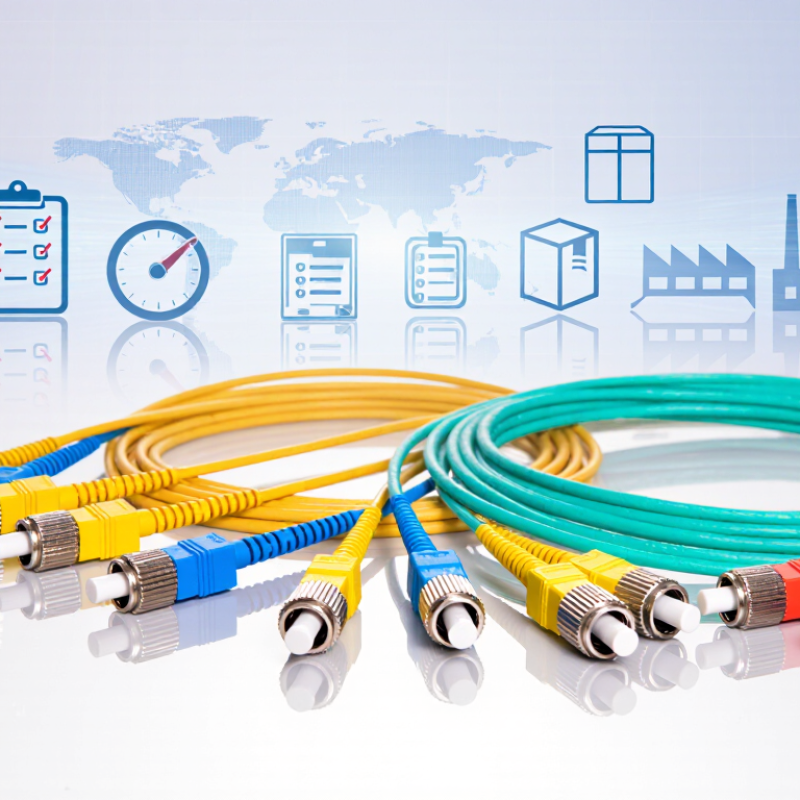
Fiber patch cords connect optical equipment, panels, and distribution boxes with controlled signal loss. Their construction usually includes a fiber core, protective jacket, connectors, and strain relief. Simplex cords carry one optical path, while duplex cords carry two. That difference affects equipment layout and polarity planning.
Single-mode OS2 cords suit long-distance telecommunications, campus networks, and high-capacity links. Multimode OM3, OM4, and OM5 cords commonly serve short data-center connections. LC connectors save rack space. SC connectors offer a larger push-pull design. MPO-style connectors support high-density parallel links, but polarity errors can stop an entire circuit.
Standards matter during global purchasing. Buyers should check ISO/IEC 11801, TIA-568.3-E, and relevant IEC connector requirements. Look for documented insertion loss, return loss, end-face geometry, and polarity results. Factory test reports are useful. Still, paperwork alone is not enough. Inspect packaging, connector cleanliness, jacket markings, and bend protection before installation.
Applications vary by environment. Low-smoke, halogen-free jackets can support indoor facilities where fire performance matters. Armored cords may help in exposed industrial routes. Bend-insensitive fiber is practical around crowded cabinets. I have seen projects fail because technicians matched connector shapes but ignored fiber modes. It looked correct. It was not.
Global buyers should confirm length tolerance, labeling, test methods, and replacement availability. A reliable supplier should answer technical questions clearly and provide traceable inspection records. Even experienced teams can miss polarity details during urgent deployment. A second verification remains worthwhile.
Key Criteria for Comparing Global Fiber Patch Cord Suppliers
Comparing global fiber patch cord suppliers requires more than checking unit price. The Fiber Broadband Association’s 2024 report noted over 80 million U.S. homes passed by fiber, increasing pressure on installation quality and supply continuity. Buyers should request clear specifications for fiber type, connector polish, insertion loss, return loss, and bend radius. Small differences matter. A 0.3 dB connector loss can become significant across dense distribution frames.
Standards provide a practical comparison point. Suppliers should demonstrate testing aligned with IEC 61300 procedures and connector interfaces referenced by IEC 61754. Ask for factory test records, calibration dates, batch numbers, and sample inspection results. Reliable suppliers can explain whether cords use G.652.D or G.657.A2 fiber, and where each type fits. The ITU-T G.657 recommendation supports improved bend performance, but “bend-insensitive” does not mean damage-proof.
Delivery evidence matters too. The 2024 Logistics Performance Index shows how uneven international shipping performance remains across markets. Compare lead-time history, packaging tests, customs documentation, and replacement procedures. A supplier with strong engineering may still fail during peak demand. That is an uncomfortable reality. Request a pilot order before approving a large contract, then measure actual attenuation, connector cleanliness, labeling accuracy, and carton protection. No checklist is perfect. Photographs and spreadsheets can also miss field handling problems.
Leading Supplier Categories Across Major Global Markets
Top Fiber Patch Cord Suppliers for Global Buyers
Leading Supplier Categories Across Major Global Markets
Global buyers usually encounter four supplier categories: specialist cable assemblers, regional distributors, data-center integrators, and large network-equipment channels. Each serves a different purchasing reality. Specialist assemblers often provide custom lengths, polarity, connector types, and low-smoke jackets. Regional distributors offer faster delivery, local documentation, and easier returns. Integrators add testing and installation support, which matters when hundreds of cords enter a dense rack.
Demand is expanding with fiber access and cloud infrastructure. The OECD Broadband Portal reported that fiber represented about 42% of fixed broadband connections across OECD economies in 2023. The FTTH Council Europe Market Panorama 2024 also projected continued growth in European fiber coverage. These figures do not guarantee stable patch-cord quality. They only show the pressure placed on supply chains.
Regional priorities vary. European buyers commonly request CPR documentation and precise insertion-loss records. North American projects often emphasize ANSI/TIA compatibility and rapid replenishment. Asian markets may prioritize high-volume production, compact packaging, and competitive lead times. Middle Eastern and African buyers need stronger export packing and climate-aware storage guidance. Small details matter.
A reliable supplier should provide IEC-related test records, end-face inspection images, batch traceability, and clear tolerances. Ask for sample measurements before committing to volume. Price alone misleads. I have seen sourcing plans favor short delivery times, then overlook connector polish consistency. That mistake becomes expensive during commissioning. Supplier categories overlap, and no category is automatically superior.
Quality Control, Certifications, and Customization Capabilities
Global buyers should assess fiber patch cord suppliers through measurable quality controls, not attractive catalogs. The ITU Facts and Figures 2023 report estimated 5.4 billion people were online, increasing pressure on reliable network infrastructure. Suppliers should document insertion loss, return loss, end-face geometry, polarity, and visual inspection results for every production batch.
Certification matters, but certificates need context. The ISO Survey 2023 recorded more than 1.2 million ISO 9001 certificates worldwide. ISO 9001 can demonstrate controlled processes, yet it does not automatically prove optical performance. Buyers should also request compliance evidence for IEC 61754 connector interfaces and ISO/IEC 11801 structured cabling requirements. Independent laboratory reports are more convincing when they show test methods, equipment calibration, and sample sizes. A certificate alone is not enough.
Customization separates capable suppliers from simple resellers. Options may include OS1, OS2, OM3, OM4, or OM5 fiber, different jacket materials, bend-insensitive construction, pull-eye protection, and exact cable lengths. Polarity can be configured for duplex transceivers and high-density panels. Clear labeling helps technicians trace links inside crowded racks. However, customization can introduce inconsistency. Suppliers should approve drawings, retain samples, and repeat insertion-loss testing after design changes. One practical concern remains: some buyers focus heavily on price and overlook packaging. Crushed ferrules, loose dust caps, or poor coil control can damage a perfect optical design before installation.
Top Fiber Patch Cord Suppliers for Global Buyers
Quality control, certifications, and customization capabilities
This buyer-oriented comparison uses a 100-point evaluation framework. Quality control covers end-face inspection, insertion-loss testing, return-loss testing, polarity verification, and traceability. Certification and customization scores reflect commonly requested international compliance and product configuration capabilities rather than data from any specific company or brand.
Pricing, Logistics, and After-Sales Support for International Buyers
Top Fiber Patch Cord Suppliers for Global Buyers
International buyers should compare landed cost, not only the quoted unit price. A fiber patch cord may cost less, yet customs handling, connector cleaning, and replacement freight can erase the saving. Cisco’s Annual Internet Report forecast global IP traffic would reach 396 exabytes per month by 2022, up from 122 exabytes in 2017. This growth increases pressure on stable, high-volume fiber supply.
Request pricing by fiber type, connector polish, length, jacket rating, packaging, and test documentation. Ask for insertion-loss and return-loss results for every production batch. ISO/IEC 11801 and IEC 61754 references help buyers compare specifications consistently. The World Bank’s Logistics Performance Index 2023 assessed 139 economies through 4,090 logistics professionals. Its findings highlight customs, tracking, and delivery timeliness as major supply-chain differences. Small delays become expensive during data-center deployment.
Plan shipments with clear Incoterms, carton dimensions, and backup carriers. Keep spare cords locally when downtime costs exceed freight savings. After-sales support should include response-time commitments, photo-based inspection, replacement procedures, and multilingual technical assistance. A shared serial-number record improves traceability.
Do not trust a polished quotation alone. Sample testing can reveal weak boot design or inconsistent polarity. My practical concern is simple: buyers sometimes compare price before defining acceptance criteria. That approach needs reconsideration. Reliable suppliers should explain limitations, not promise perfect performance.
Top Fiber Patch Cord Suppliers for Global Buyers - Pricing, Logistics, and After-Sales Support for International Buyers
| Supplier Profile | Common Product Scope | Indicative Unit Price* | Typical MOQ | Production Lead Time | International Logistics | Quality Documentation | After-Sales Support |
|---|---|---|---|---|---|---|---|
| High-volume Asian manufacturer | Duplex single-mode and multimode patch cords, LC, SC, ST, and FC connector options | US$0.80–4.50 per cord | 100–500 pieces | 7–15 working days for standard items; 15–25 days for customized items | Courier, air freight, or sea freight; export documentation commonly available | Insertion-loss and return-loss test reports; material and visual inspection records | Remote technical support, replacement for confirmed defects, and photo-based claim review |
| Regional contract manufacturer | Standard and customized lengths, bend-insensitive fiber, pull-proof boots, and polarity options | US$1.50–8.00 per cord | 50–200 pieces | 10–20 working days | Better suited to mixed-SKU shipments; consolidated air freight available | Batch traceability, connector-endface inspection, and dimensional inspection | Engineering consultation, sample approval, and structured RMA handling |
| Certified data-center supplier | Low-loss single-mode assemblies, duplex and parallel-fiber designs, high-density rack solutions | US$3.00–18.00 per cord | 25–100 pieces | 10–25 working days, depending on test and configuration requirements | International air freight and scheduled project deliveries; export packing available | Individual test records, endface images, polarity verification, and product traceability | Pre-deployment compatibility review, installation guidance, and project-level escalation |
| Small-batch customization specialist | Non-standard lengths, fan-out assemblies, armored cables, hybrid connectors, and custom labels | US$4.00–25.00 per cord | 10–50 pieces | 15–30 working days | Courier or air freight; suitable for prototypes and urgent replacement orders | Custom drawing approval, sample inspection, and final optical test report | Dedicated order contact, design revisions, and replacement support for manufacturing defects |
| Distributor with local inventory | Frequently used LC-LC and LC-SC assemblies, standard lengths, and common polarity configurations | US$2.50–12.00 per cord | 1–20 pieces | Same day to 5 working days when stocked | Domestic fulfillment, parcel delivery, and expedited international shipping | Supplier test certificates and incoming-goods inspection records may be available | Fast replacement, local returns, telephone support, and basic product guidance |
| Project-focused fiber-system integrator | Patch cords supplied with racks, panels, cassettes, labeling, and complete structured-cabling packages | US$5.00–30.00 per cord when purchased as part of a project | 50–500 pieces per project | 20–45 working days for coordinated project supply | Milestone-based shipping, palletized export packing, and site delivery coordination | Project bill of materials, inspection plans, test documentation, and labeling schedules | Installation assistance, commissioning support, warranty coordination, and training |
*Prices are indicative international purchasing ranges for standard fiber patch cords and may vary according to fiber type, connector grade, length, polish type, test requirements, packaging, order volume, shipping terms, and destination. Freight, customs duties, taxes, and certification costs are generally excluded.
Related Posts
-
How to Choose the Right Fiber Patch for Your Needs?
-
How to Convert Cable to Fiber for Better Internet Speed?
-

Why Choose Fiber Optic Ethernet Cable for Global Networks?
-
7 Essential Tips for Choosing the Best Fiber Optic Termination Kit for Your Projects
-
How to Use Fiber Patch for Enhanced Connectivity and Performance?
-
Best Fiber Optic Termination Kit for Fast and Easy Setup?